''Solar Energy: The Future Energy''

The major turning point came in 1954, when scientists at Bell Labs in the United States created the first silicon-based solar cell. Although extremely expensive and inefficient at the time, this invention marked the beginning of solar power as a viable energy source. In the following decades, solar technology began to gain attention, especially during the oil crises of the 1970s, when countries began looking for alternatives to fossil fuels. The environmental movement of the late 20th century also helped push solar energy into the spotlight, raising awareness about renewable sources and their importance in reducing pollution and combating climate change.
Fast forward to today, and solar energy has become one of the fastest-growing energy sources in the world. Thanks to rapid technological improvements, falling installation costs, and growing government incentives, solar panels are now a common sight not only on rooftops of homes and businesses, but also in large solar farms across deserts and open lands. Countries like China, India, the United States, Germany, and Australia are investing billions in solar infrastructure. In fact, solar power accounted for nearly 60% of all new electricity-generating capacity added globally in 2024, showing how central it has become to energy planning.
As the world faces rising energy demands and urgent climate challenges, solar energy stands out as a clean, abundant, and increasingly affordable solution. It is no longer just a futuristic dream it is a key player in the present and future of global energy.
China's Leap in Solar Energy
China’s journey in solar energy began in the 1970s with small-scale experiments focused mainly on solar thermal systems for rural water heating. During this early phase, photovoltaic (PV) technology was largely ignored due to high costs and lack of domestic demand. However, as rural electrification became a national priority in the 1990s, international support helped introduce basic solar PV systems to remote areas without access to the power grid.
The real turning point came in the 2000s, when China decided to invest heavily in solar manufacturing. Backed by state policies, subsidies, and low interest loans, Chinese companies like Suntech and Trina Solar rapidly grew into major global exporters. While most panels were initially sent abroad, the government soon recognized the need for domestic solar development. Programs like the Golden Sun initiative and feed-in tariffs helped spark large-scale solar installations across the country.
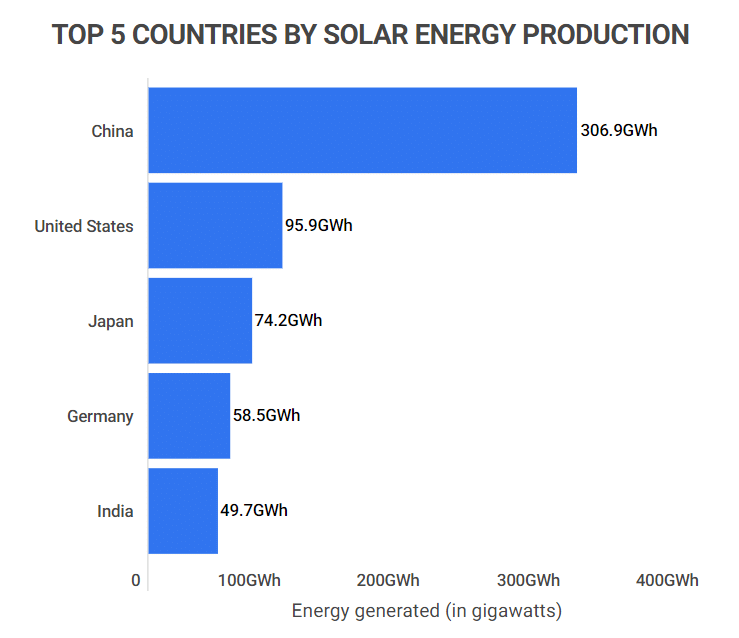
Since the 2010s, China has become the world’s largest producer and consumer of solar energy. With massive solar farms in deserts, floating installations on lakes, and continuous investment in innovation, China now leads both in capacity and manufacturing. Its solar rise is the result of long-term planning, industrial policy, and a strong commitment to renewable energy.
Chin's Monopoly in Solar Panel Production
China holds a near-monopoly in the global solar panel industry, controlling more than 80% of the world’s solar panel production across key stages from polysilicon refining to final panel assembly. This dominance is the result of massive government support, low-cost manufacturing, and early strategic investment. Chinese companies like LONGi, Trina Solar, JA Solar, and JinkoSolar lead global exports, supplying affordable panels to nearly every continent.
In terms of production capacity, China manufactures over 400 gigawatts (GW) of solar panels annually, far exceeding domestic needs. Most other countries, including major economies like the United States and Germany, rely heavily on Chinese imports to meet their solar goals. This heavy dependence has raised concerns about supply chain risks, but alternatives remain limited due to China’s unmatched scale and pricing advantage.
China’s grip on the solar panel market has not only given it economic power but also geopolitical leverage in clean energy transitions. As the world pushes for net-zero emissions, China’s manufacturing capacity puts it at the center of the global energy shift. While some nations are trying to boost local production, catching up to China’s scale and cost efficiency remains a distant goal.
China vs USA: A Solar Power Gap
While the United States has made significant strides in solar technology and clean energy policies, it still lags far behind China in solar panel production and deployment. China’s massive manufacturing scale, government support, and control over critical raw materials have given it a clear advantage. In contrast, the U.S. is still building its supply chains and relies heavily on imports. If America hopes to close this gap, it must accelerate domestic production, invest in innovation, and reduce dependence on Chinese solar technology or risk falling further behind in the global clean energy race.
Comments
Post a Comment